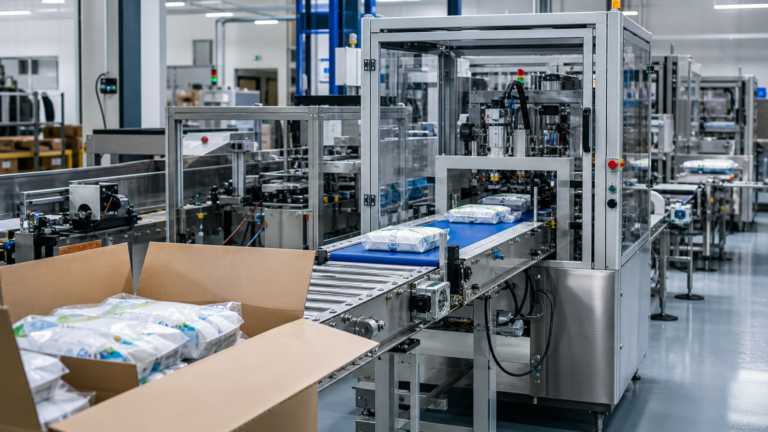


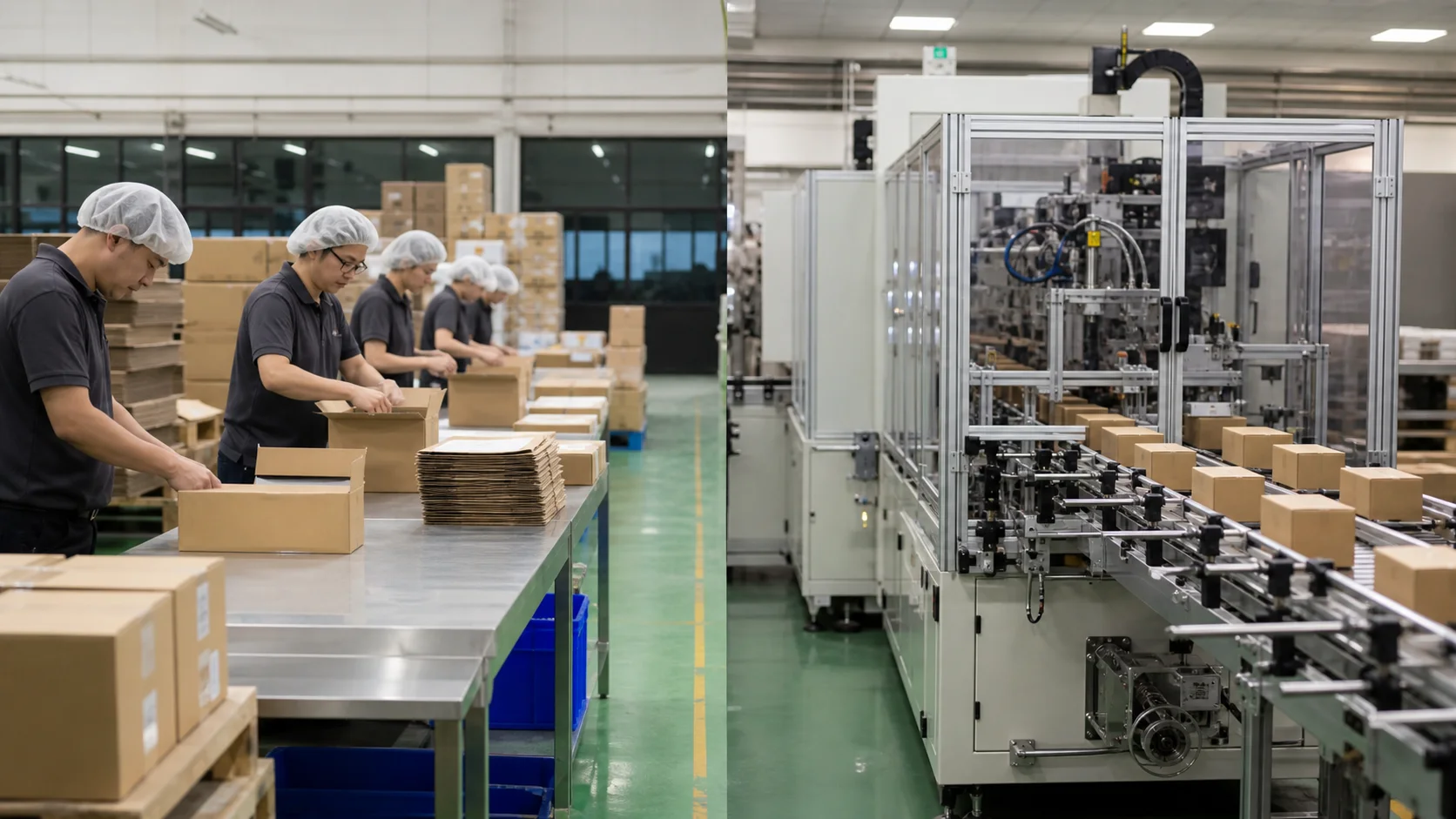
Manual packing can be practical for low volume, frequent format changes or products that require judgment and delicate handling. Packaging machinery becomes attractive when demand is repeatable enough to use the equipment effectively and when labor, output, quality and material control can be measured over a suitable period.
A useful comparison should not reduce the decision to wages versus machine price. It should examine total cost per accepted pack, available production hours, staffing risk, maintenance, changeovers and the value of capacity. This guide provides a structured method for comparing manual packing with automated equipment.
Define an Equivalent Packing Requirement
Both options must be assessed against the same product range, packaging materials, accepted quality standard, annual volume and operating schedule. Comparing a manual line at average output with a machine at catalogue maximum speed produces an unreliable result.
Measure Accepted Output
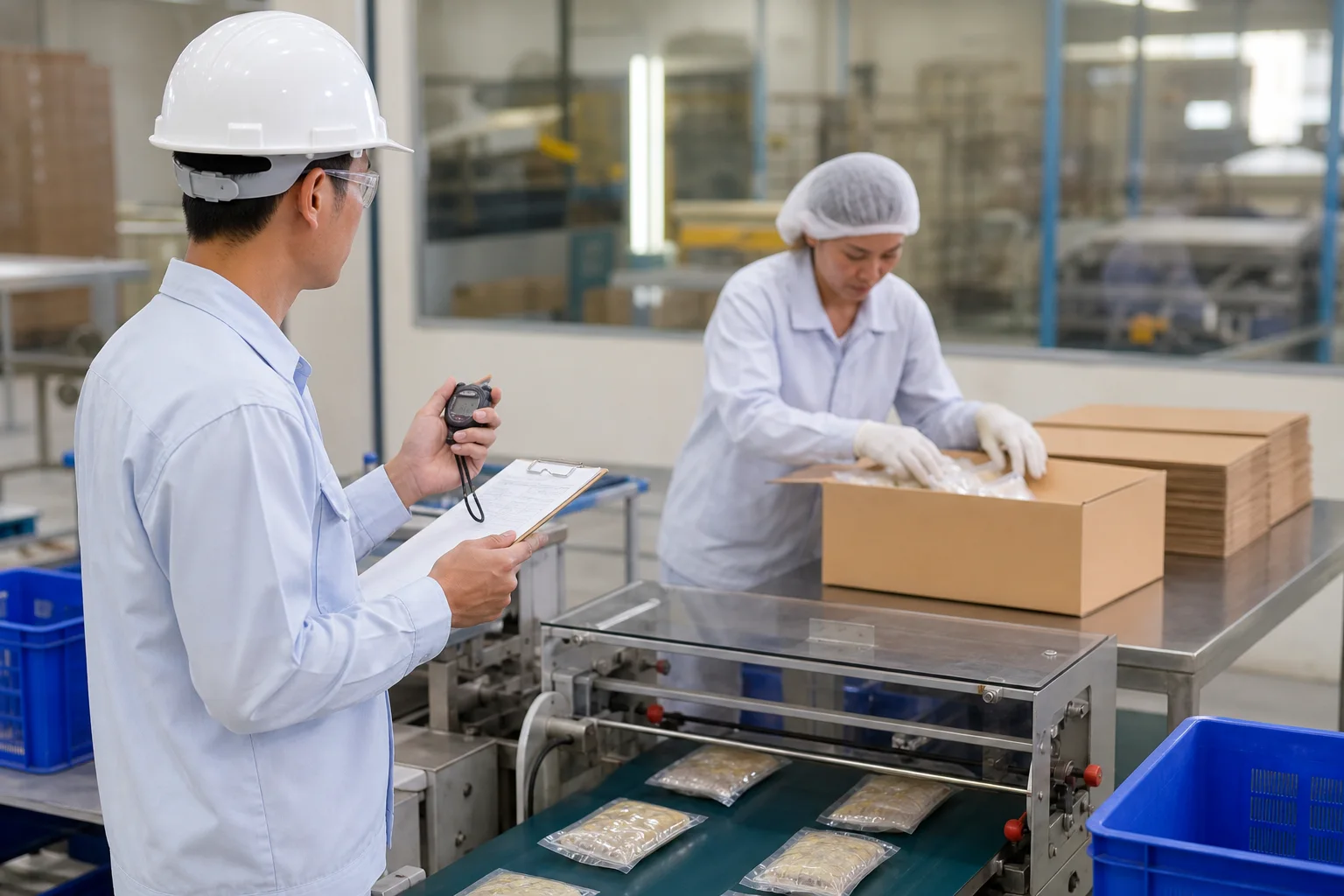
Record good packs at the end of the process after rejects and rework. Include breaks, material replenishment, quality checks and normal product changes. For machinery, use a sustained rate supported by upstream and downstream operations.
Use Representative Shifts
Collect information across different teams and products. One short observation may not capture normal variation in attendance, product behavior or material quality.
Document the Acceptance Standard
Define correct count, seal, code, appearance and carton closure before timing the work. Faster output has limited value if additional packs later require correction.
Calculate the Full Cost of Manual Packing
Direct wages are the starting point, but the complete labor cost may also include overtime, benefits, supervision, recruitment, training, protective equipment and temporary coverage. The calculation should follow the organization’s approved financial method.
Manual Packing Cost per Unit
Manual packing cost per accepted unit = Total annual manual packing cost ÷ Annual accepted units
Add the cost of rework, damaged product and packaging waste attributable to the manual process. If staff also perform inspection or material preparation, allocate only the time related to the compared packing scope.
Calculate the Full Cost of Packaging Machinery
The equipment option includes the installed project cost and its recurring operating expenses. Capital items may include the machine, conveyors, guarding, format parts, coding, inspection, freight, utilities, installation, commissioning and training.
Annualize the Investment Consistently
For a unit-cost comparison, finance may spread the investment over an approved useful life or use a lease or financing cost. For a capital decision, the factory may instead calculate cash flow, ROI and payback. The article on packaging machine payback explains the distinction.
Include Recurring Expenses
Energy, compressed air, maintenance labor, wear parts, consumables, software and scheduled service must be deducted from the benefit. Machine operators and material handlers should also remain in the staffing model.
Use Expected Utilization
A machine operating one short campaign per month carries a different cost per pack from the same machine used across two shifts. Include realistic product demand, planned maintenance and changeover time.
Illustrative Manual vs Machine Cost Model
The following structure shows how the two methods can be compared. Values should be replaced with factory records and supplier information.
| Annual Cost Item | Manual Packing | Packaging Machine |
|---|---|---|
| Labor and supervision | THB 2,400,000 | THB 900,000 |
| Overtime and temporary coverage | THB 420,000 | THB 120,000 |
| Waste and rework | THB 380,000 | THB 180,000 |
| Energy, maintenance and service | THB 60,000 | THB 520,000 |
| Annualized equipment investment | THB 80,000 | THB 800,000 |
| Total annual cost | THB 3,340,000 | THB 2,520,000 |
If the manual method produces 2.0 million accepted packs and the machine produces 2.4 million, the annual cost per accepted pack is approximately THB 1.67 and THB 1.05 respectively. The illustration does not include tax, financing or revenue from additional sales.
Run a Break-Even Volume Test
Calculate the annual volume at which the lower variable cost of machinery offsets its higher fixed cost. This helps determine whether current demand supports automation and how sensitive the decision is to future volume.
Compare Flexibility, Quality and Operating Risk
When Manual Packing Remains Suitable
Manual work may remain appropriate for short campaigns, unstable product design, highly varied presentation, delicate handling or low annual volume. It can also support new-product trials before the pack format becomes stable.
When Machinery Becomes Suitable
Automation is generally stronger when products arrive consistently, the pack format is defined, demand is repeatable and the equipment can be used enough to distribute fixed cost across many units. Reviewing the types of packaging machines can help identify which process should be automated first.
Consider a Hybrid Process
A hybrid line may automate carton forming, sealing, coding or repetitive transfer while retaining manual loading for products that require flexibility. This can reduce investment and preserve skilled handling where it has the greatest value.
Choose the Suitable Packing Approach
Prepare conservative, expected and high-volume scenarios. Compare annual cost, cost per accepted pack, staffing plan, capacity, quality and investment return. Confirm the result through product trials and acceptance criteria before placing an order.
- Use the same products, quality standard and annual volume
- Include all labor and recurring machine costs
- Measure accepted output rather than peak speed
- Test the full expected product and material range
- Separate cash savings from reassigned capacity
- Review payback and long-term operating value
Frequently Asked Questions
Is manual packing always less expensive for low volume?
Often, but not always. Quality requirements, labor availability, product value and repetitive handling may justify partial automation even at moderate volume.
How should reassigned employees be treated?
Record the operational capacity released and any verified avoided recruitment or overtime. Do not present the full wage as a cash saving if employment cost remains unchanged.
Can one machine handle several products?
Yes, when the size range and changeover method are defined during design. Representative products and packaging materials should be tested before final approval.
Compare Your Packing Options with Practical Data
Newgate Machine can review your products, present packing method, required output and available space to help define an appropriate manual, hybrid or automated solution.