



Pharmaceutical packaging machinery should support controlled handling, clear coding, inspection and consistent line operation for medical supplies. Packaging for pharmaceuticals and medical supplies performs several duties at once. It protects the product during handling and distribution, presents information in a controlled format, supports identification and traceability, and prepares each unit for storage or use. The machinery behind those steps must handle products and packaging materials consistently while fitting the manufacturer’s quality system and production process.
Selecting pharmaceutical packaging machinery therefore begins with more than a required speed. Product characteristics, packaging level, environmental conditions, inspection requirements, cleaning procedures, changeovers and documentation all influence the final solution. This guide provides a practical framework for reviewing equipment used with medicines, healthcare products and medical supplies. Specific regulatory and validation requirements should always be confirmed by the manufacturer for the product and markets concerned.
Packaging Levels for Pharmaceuticals and Medical Supplies
A useful equipment review starts by identifying the packaging level. Primary packaging is in direct contact with the product. Secondary packaging groups or encloses the primary pack, while tertiary packaging prepares larger quantities for storage and transport. Each level has different material, handling and inspection requirements.
Primary Packaging Formats
Common pharmaceutical formats include blister packs, bottles, sachets, pouches, tubes and prefilled containers. Medical supplies may use trays, pouches, cartons or other protective systems selected according to the product and its intended distribution conditions. Primary packaging equipment must be specified for the exact material structure, sealing process and product presentation.
Product Contact and Environmental Requirements
Where machinery or tooling contacts the product or its immediate packaging, the selected materials, surface finishes and cleaning methods should suit the manufacturer’s process. Temperature, humidity, dust control and room classification may also affect machine construction and installation. These conditions should be documented before equipment is shortlisted.
Secondary Packaging Formats
Folding cartons are widely used to contain blister packs, bottles, tubes, leaflets or medical products. Cartons provide a structured surface for identification and help organize units for distribution. The loading method may be horizontal or vertical, depending on the product shape, carton design and required insertion sequence.
Leaflets, Inserts and Pack Components
Some formats require folded leaflets, instruction sheets, applicators or other components to be included with the product. The line should confirm the presence and position of required items before the carton is closed. Feeding reliability depends on component dimensions, paper condition, fold style and the way materials are replenished.
Tertiary Packaging for Distribution
After secondary packaging, products may be counted, grouped and loaded into corrugated cases. Case sealing, labeling, strapping and pallet preparation support controlled warehousing and transport. The case format and packing pattern should protect saleable cartons while allowing efficient downstream handling.
Essential Machinery in a Pharmaceutical Packaging Line
A complete line is assembled from machines that perform defined tasks and exchange products in a controlled sequence. Not every project requires every function, but the following groups are commonly reviewed.
Product Feeding and Orientation
Blister packs, bottles, cartons and flat components must arrive at the next station in the correct orientation and spacing. Conveyors, friction feeders, suction feeders, timing belts and pick-and-place devices can provide this control. Product stability, surface sensitivity and allowable contact determine the appropriate method.
Cartoning Machinery
Cartoning equipment erects a folding carton, loads the product and required components, and closes the carton using the specified flap or adhesive method. A review of pharmaceutical cartoning machinery should consider product loading direction, carton dimensions, leaflet handling, closure design, output rate and available floor space.
Horizontal and Vertical Loading
Horizontal machines load products through the carton side and are often suitable for blister packs, tubes and other items presented in a stable orientation. Vertical machines load from above and may suit bottles, containers or grouped items. Sample testing is important because nominal dimensions do not fully describe how a product behaves during transfer.
Coding and Marking Equipment
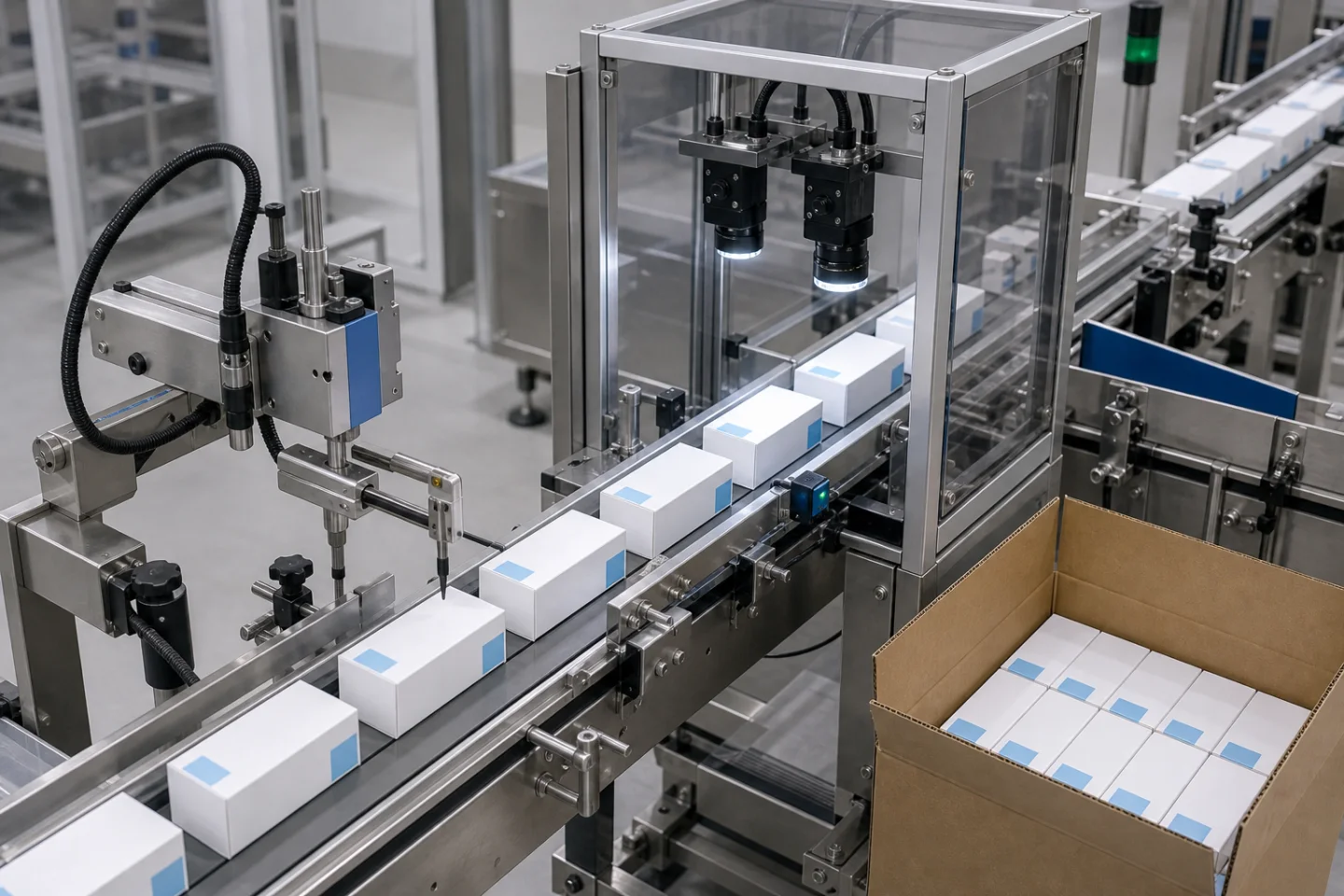
Cartons and cases may require batch information, production or expiry data, barcodes or other identifiers defined by the manufacturer’s process. An inkjet coding system can be integrated with conveyors and inspection equipment when the ink, print surface, code quality and line speed are suitable for the application.
Vision Inspection and Reject Handling
Inspection cameras and sensors can verify selected features such as carton presence, orientation, closure, code position or component inclusion. A defined rejection mechanism separates non-conforming packs from accepted production. The reject path should be secure, accessible to authorized personnel and monitored according to the site’s procedures.
Case Packing and End-of-Line Equipment
Accepted cartons can be counted, collated and loaded into shipping cases by mechanical or robotic systems. Carton erectors, case sealers, labelers and pallet-handling equipment then prepare finished cases for the warehouse. The chosen arrangement should maintain product identity and avoid mixing during product changes.
How to Select Suitable Pharmaceutical Packaging Machinery
Equipment selection is most reliable when the project team prepares a structured requirement based on actual products, approved packaging materials and expected operating conditions.
| Review Area | Information to Confirm | Equipment Impact |
|---|---|---|
| Product and pack | Dimensions, weight, orientation, fragility and approved tolerances | Defines feeding, guides, tooling and transfer method |
| Packaging material | Carton board, film, foil, leaflet and case specifications | Affects forming, feeding, sealing and code adhesion |
| Production | Normal output, peak output, shifts and product-change frequency | Guides speed, accumulation and changeover design |
| Quality controls | Required checks, rejection logic, records and access controls | Defines sensors, cameras, software and reject handling |
| Facility | Layout, utilities, environment, cleaning and service access | Influences construction, footprint and installation |
Use Approved Samples and Realistic Tolerances
Machine trials should include representative products and packaging materials across the approved dimensional range. Carton stiffness, leaflet curl, blister flatness and surface reflectivity can affect feeding and inspection. Testing several lots provides a more realistic basis for machine settings and acceptance criteria.
Plan Changeovers Before Finalizing the Machine
Where multiple products share one line, changeover requirements should be defined at the design stage. Adjustment points, recipe controls, format parts, line clearance and verification steps all affect the time required to prepare the next run. Clear identification and storage of format parts supports orderly operation.
Review Cleanability and Access
Surfaces should be accessible for the cleaning methods specified by the manufacturer. Guards, conveyors, tooling and product-contact areas should allow inspection without creating unnecessary dismantling. Maintenance access must also be considered so routine work can be carried out without disturbing critical alignment.
Quality Control, Identification and Traceability
Pharmaceutical and medical-supply packaging lines require clearly defined acceptance criteria. The machinery should support the manufacturer’s checks and records without replacing the site’s quality responsibilities.
Define Every Inspection Function
Each sensor or camera should have a documented purpose, such as confirming a leaflet, reading a code, checking carton orientation or detecting an open flap. The expected response to a failed check should also be defined. This includes line stop, rejection, alarm, record creation and operator action where applicable.
Challenge Tests and Reject Verification
Inspection and rejection functions should be tested using agreed challenge samples or procedures. The test method, frequency and result records depend on the manufacturer’s quality system. Reject containers and access controls should support secure handling and reconciliation.
Code Readability and Position
Code quality depends on the printer, ink, substrate, product speed and distance from the print head. The code should be applied at a stable point in the conveyor path and inspected against defined requirements. Sample approval should include material from normal production suppliers.
Prevent Product and Component Mixing
Line layout, material staging, recipe selection and line-clearance procedures should help maintain product identity during startup and changeover. Equipment should provide suitable access for clearing remaining cartons, leaflets, labels and products before the next batch begins.
Line Integration and Validation Planning
Individual machines must operate as one controlled process. Conveyor heights, product handoffs, accumulation, machine states and communication signals should be agreed before installation. An integrated pharmaceutical packaging system can coordinate the mechanical layout, electrical interfaces and control sequence across several stations.
Balance the Line Around Sustained Output
The practical output is determined by the complete line, not the fastest machine. Upstream supply, leaflet feeding, inspection time, rejection and case handling can influence the sustained rate. Short accumulation zones may absorb normal interruptions, provided the products can be buffered without damage or loss of order.
Prepare Documentation Early
The project should define the documents required for design review, installation, operation, maintenance and qualification activities. Typical documentation may include drawings, component lists, manuals, calibration information, software descriptions, alarm lists and test records. The final list should reflect the manufacturer’s quality and validation plan.
Agree on Acceptance Testing
Factory and site acceptance tests should use agreed products, materials and operating scenarios. Tests may review output, changeovers, alarms, inspection functions, reject handling and recovery after stops. Recording expected results before testing helps the customer and supplier evaluate the same requirement.
Maintenance and Daily Operation
Packaging equipment retains its intended performance through routine inspection, cleaning, calibration and replacement of wear components. The maintenance plan should identify tasks, intervals, responsible personnel and the records required by the site.
Establish a Practical Spare-Parts Strategy
Belts, vacuum cups, blades, heaters, sensors, printer consumables and pneumatic components may require planned replacement. Spare-part selection should consider wear rate, delivery time, storage conditions and the effect of a component on production. Critical parts should be identified during project handover.
Train Operators and Technical Teams
Operators need clear instruction on startup checks, material loading, recipe selection, normal alarms, quality checks and line clearance. Technical teams require drawings, parameter references and safe troubleshooting procedures. Training with actual products and approved materials makes these instructions easier to apply.
Control Changes to the Equipment
Changes to tooling, software, sensors, code settings or inspection logic should follow the manufacturer’s established change-control process. Updated drawings, settings and test evidence help keep the machine configuration and operating documentation aligned.
Frequently Asked Questions
What packaging machinery is commonly used for blister packs?
After blister formation and sealing, the packs may pass through inspection, feeding, cartoning, coding, case packing and end-of-line equipment. The exact arrangement depends on the product, carton format, required components and output.
Can one cartoning machine handle several medicine carton sizes?
A machine can support a defined size range when its guides, tooling, feeders and controls are designed for those formats. Representative samples should be tested, and the required format parts and changeover method should be agreed before purchase.
Can new packaging machinery connect to an existing line?
In many projects it can. The review should confirm conveyor levels, product transfer, available space, utilities, machine signals, safety circuits, inspection requirements and the validation approach before the interface is finalized.
Discuss Your Pharmaceutical Packaging Project
Newgate Machine supports manufacturers in reviewing products, packaging materials, cartoning, coding, inspection, conveyors and end-of-line integration. A technical discussion based on representative samples, target output, layout and quality requirements provides a clear starting point for equipment selection.